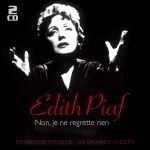
Piaf, Edith
Non, Je Ne Regerette Rien
Édith Piaf was born on December 19, 1915, in Paris. Her mother abandoned her shortly after birth and she initially grew up with her maternal grandmother, where she nearly starved to death. Her father then entrusted her to her mother, who ran a brothel in Normandy. From the age of ten, her father, an alcoholic and violent, took her on tour with a traveling circus. At fifteen, she left her father and worked as a street singer in Paris, where she became known as "La môme Piaf," or the little sparrow. Her first record came out in 1935. In 1936, she achieved success with "Mon légionnaire," followed by other hits such as "L'accordéoniste" (1940). Shortly after the war, she achieved one of her biggest hits with "La vie en rose" (1947). Following a car accident with her then-lover Georges Moustaki, Édith Piaf underwent several operations and had to use morphine for a long time to dull the pain, becoming addicted for the rest of her life. In the late 1950s, after collapsing on stage, she was diagnosed with terminal cancer. Despite this, Édith Piaf continued to perform, receiving morphine from a nurse who had traveled with her. During this difficult period, she achieved her greatest successes, releasing her two most successful albums, "Milord" and "Non, je ne regrette rien." In August 1963, her husband, Théo Sarapo, took his seriously ill wife to a country house in the south of France, where Édith Piaf died on October 10, 1963. Sarapo then brought her body to Paris, in obscurity, to officially pronounce her death. Over 40,000 people attended his funeral at Père Lachaise Cemetery.